

A shared direction, local solutions and an economy that respects life
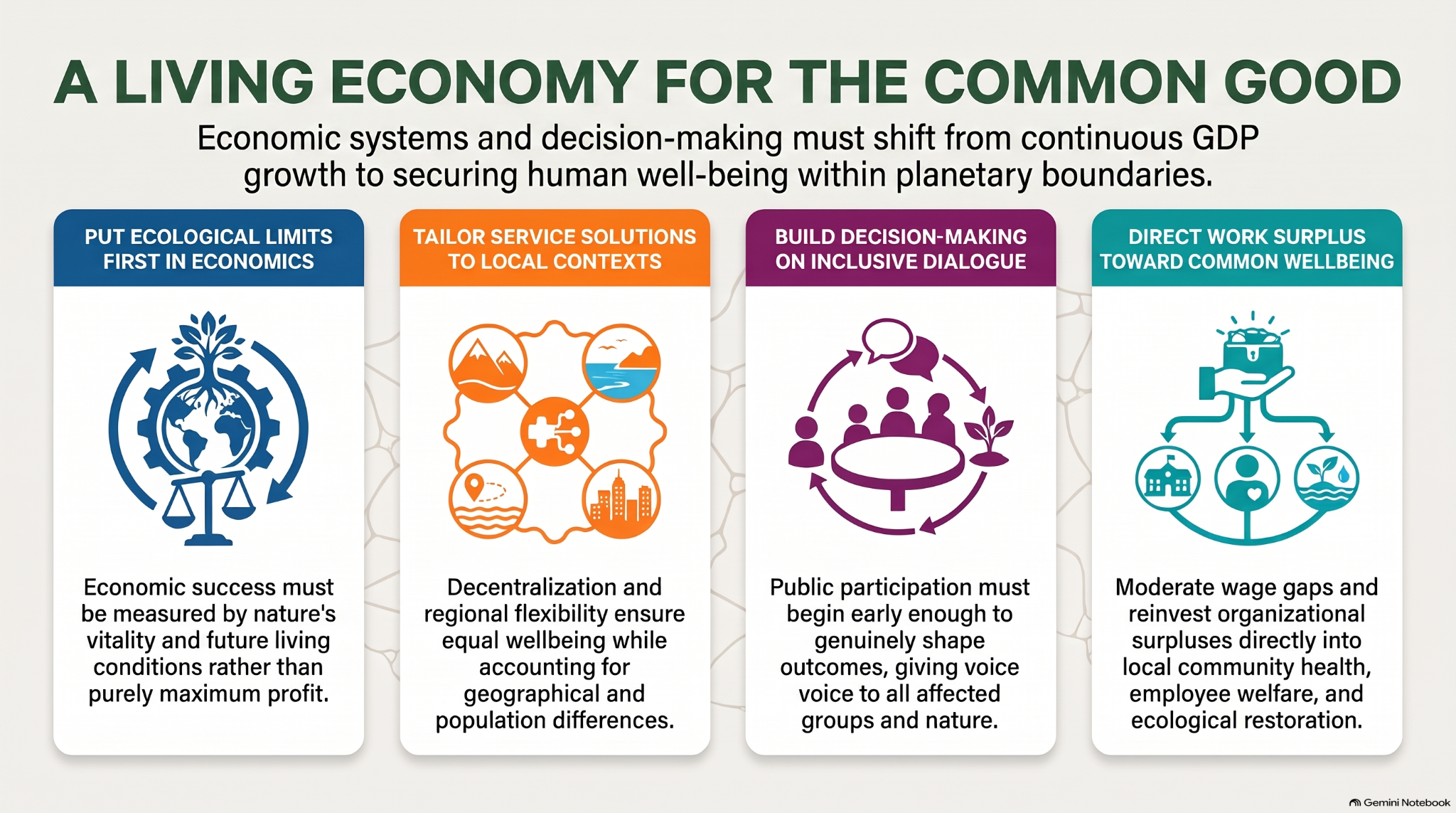
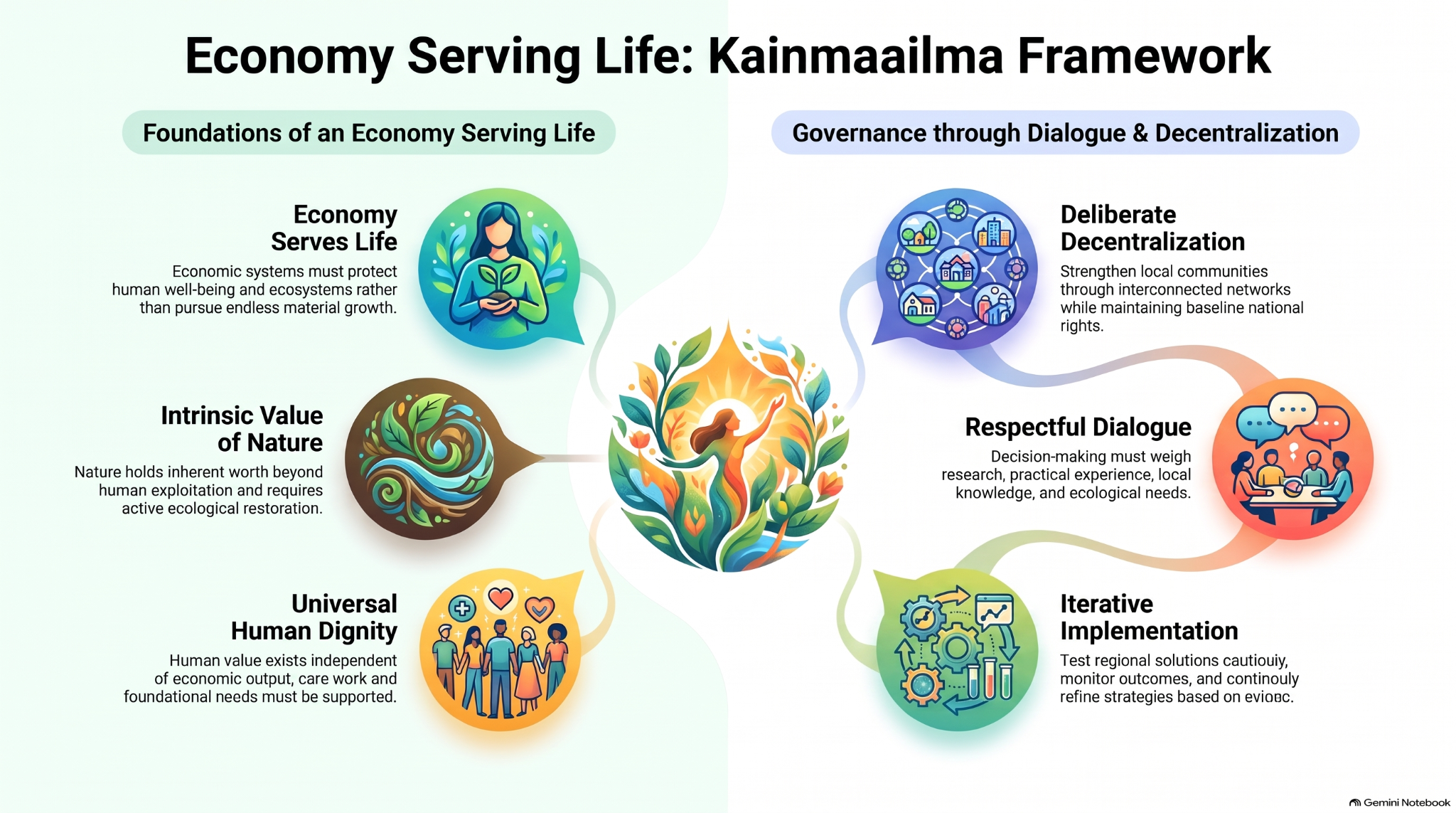
The purpose of the economy and decision-making is to safeguard the conditions for a good human life as part of a thriving, diverse natural world.
How could we organise society so that it serves people, strengthens biodiversity and creates a secure future? The search for an answer begins with what we value. When preserving life, wellbeing and the common good become our goals, we must also reconsider the foundations of the economy and decision-making.
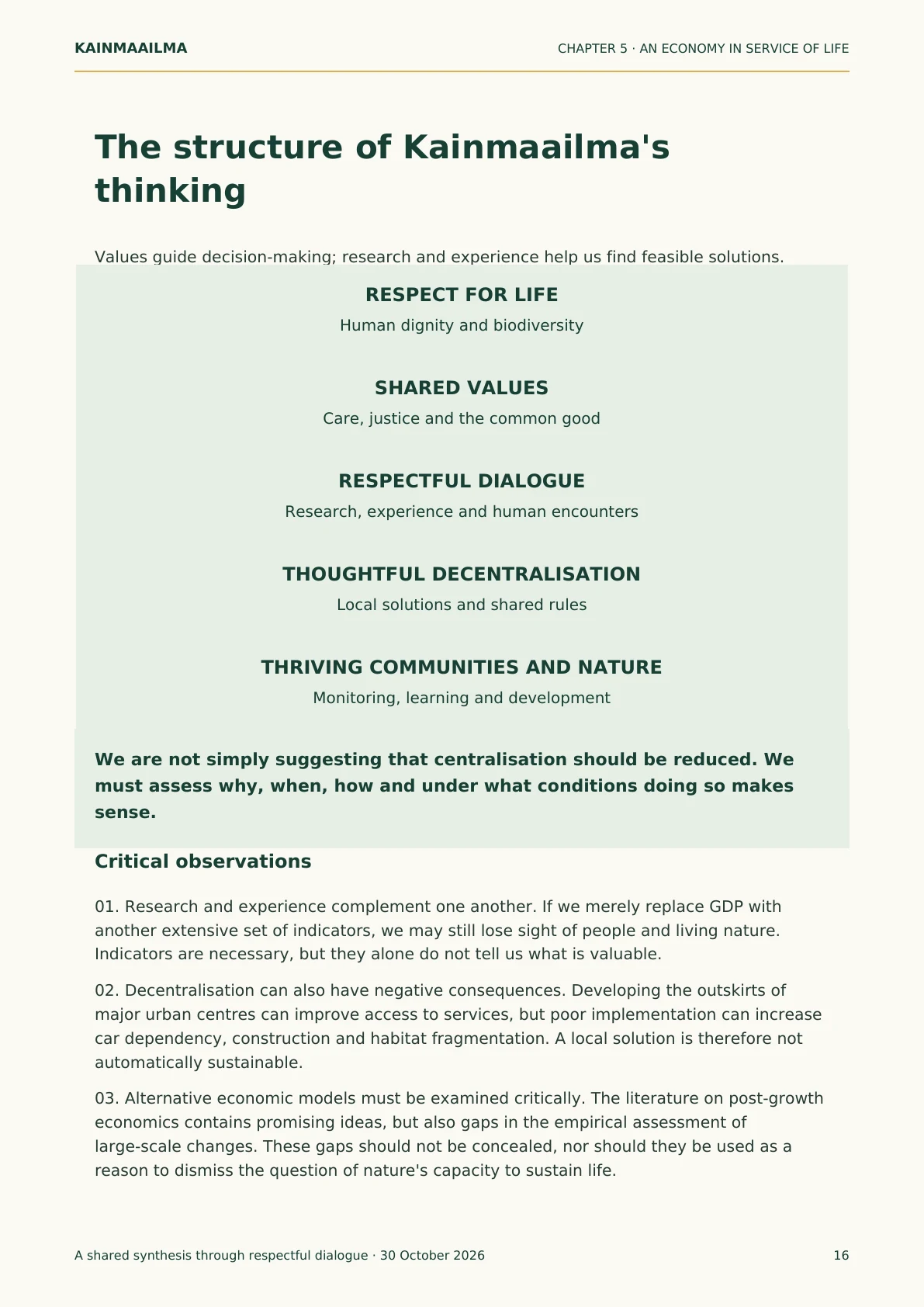
The first task is to determine what should be decentralised, what should be centralised and where a combination is needed. The answer cannot be decided in advance on the basis of a single ideal. Even the same service may need to be organised differently in an urban neighbourhood, the countryside and an archipelago.
The same security, different solutions
National laws and regulations provide the shared binding framework. Within it, local implementations must be allowed to differ. The values and proposals in this chapter do not constitute a new set of rules to be implemented identically everywhere. They offer a direction for deliberation and shared discussion.
The responsibility of the welfare society remains. Society is responsible for ensuring health care, care for older people and social services, funded collectively through taxation. Decentralisation does not require the creation of cooperatives or the transfer of service responsibilities to residents. Services may be provided by public bodies or other suitable providers within a framework of shared responsibility and agreed conditions.
Local decision-making needs adequate funding, expertise and cooperation. A person's right to good services must not depend solely on the wealth of the area in which they live.
The conditions for life come first
Respect for biodiversity must be present at every stage of decision-making. It belongs in identifying needs, preparing alternatives, implementation and monitoring impacts. Forests, waters, soil and other organisms form the living whole of which humans are also a part.
The economic analysis by Dasgupta and Levin emphasises that the economy is embedded in nature and depends on its life-supporting processes. Gross domestic product can grow while the ecological foundations of wellbeing deteriorate. Economic success must therefore also be assessed through the state of nature and the life opportunities of future generations. [1]
Asking about a good life rather than growth
In this proposal, continuous growth and the greatest possible profit for the smallest possible input are not the highest goals. We ask what we need, how it can be delivered well and how much it contributes to shared wellbeing. Work must be given enough time, expertise and resources to fulfil its purpose and respect nature.
Post-growth research examines how wellbeing can be maintained within planetary boundaries and how society's dependence on continuous GDP growth can be reduced. A 2025 review brings this research together while identifying open questions about implementing the transition and justice between countries. This is not yet an economic model proven everywhere. [2]
In a comparison of over 150 countries, no country met all basic needs at a globally sustainable level of resource use under the study's indicators. This shows the scale of the change required, not the impossibility of a good life. [3] In another study of 106 countries, good public services, income equality and democracy were associated with better need satisfaction at lower energy requirements. A statistical association alone does not establish causation. [4]
Economic sustainability enables continuity. The purpose of activity is a good life and the vitality of the natural world that sustains it.
The change concerns both economic incentives and people's values. What matters is the kind of work, business activity and way of life we regard as successful and are willing to support.
Close to needs, part of a wider whole
Planning local solutions requires knowledge of the distance to the nearest centre, transport connections, residents' needs and the area's natural characteristics. The same number of kilometres means different things to different people. Accessibility also depends on travel time, cost, functional ability and the need for personal assistance.
Elinor Ostrom's research tradition supports coordination between multiple levels of decision-making and organisations of different sizes. Centralisation offers advantages in some tasks, while local provision serves others better. A study of South Africa's nine provinces showed how greatly environmental pressures and development needs can vary within a single country. [5, 6]
The value of a service extends beyond its own budget
A Danish study of eight village school closures estimated that population development would have been 7.6 percentage points more favourable over a ten-year period without the closures. The difference only became statistically significant from the sixth year onwards. The result comes from one municipality but highlights the importance of long-term impacts. [7]
In a comparison of 1,759 non-metropolitan US counties, hospital closure reduced the size of the labour force by an estimated 1.4 per cent relative to the counterfactual. Adverse effects were generally greater when services ended completely. The population effect was not statistically significant across the full sample. [8]
Decentralisation can open up new opportunities
A British study of civil service job relocation estimated roughly 11 private-sector jobs for every ten relocated civil service jobs in the receiving local area in the short term. Some of the effect reflected businesses moving from nearby areas; it does not represent the same net increase nationwide. [9] In India, expanding the bank branch network into previously unserved areas reduced rural poverty and increased non-agricultural output. [10]
Results are not the same everywhere. A Swedish school study found no significant effect of closures on migration. [11] Service loss can be both a consequence of decline and a factor reinforcing it. These studies have not been statistically combined with Finnish data, nor do they establish centralisation as the sole cause of rural population decline.
Listening changes the solution
Respectful dialogue means wanting to understand another person and being willing to reconsider one's own views. Only by truly listening to others can we build reciprocal listening. Participation must begin early enough for discussion still to change the objectives and the plan.
Preparing a decision involves identifying who is affected and who may be left out of the discussion. The experiences of residents, workers, service users, entrepreneurs and decision-makers are brought into the same conversation. Space must also be made for people whose participation is hindered by age, language, functional ability or limited resources.
Dialogue with nature means attentive observation and a willingness to act on what we observe. Biodiversity research, local knowledge and ecological expertise help identify impacts that might otherwise be missed in negotiations between people. The life opportunities of future generations and other organisms belong in the deliberation.
From being heard to shared responsibility
Alternatives are compared before a choice is made, and concerns are addressed transparently. Taking everyone's views into account does not mean fulfilling every wish or requiring unanimity. Everyone should nevertheless be able to understand how their views were considered and why the decision was reached. Afterwards, consequences are monitored and ways to remedy shortcomings are agreed.
Research supports participation and local deliberation. In a study of participatory budgeting in Brazil, more funding went to health services and sanitation, and infant mortality fell. In Bolivia, following decentralisation of decision-making and funding, investment better reflected local needs, particularly in small and poor municipalities. [12, 13]
In an Ethiopian study, decentralisation improved primary school enrolment and access to antenatal care. [14] These findings concern specific arrangements. They do not prove that every consultation or decentralisation initiative succeeds, but they support the importance of effective participation and local responsibility.
Enduring values in decision-making are respect for others, a long-term perspective, the common good, and the preservation of life and biodiversity.
A shared result comes from many people's work
Behind a product or service is a work process in which tasks support one another. Planning, production, care, maintenance, cleaning, transport and management make the success of the whole possible. Everyone has a place. The visibility of a task or its position in an organisation does not alone determine its importance.
Respect for work must be reflected in pay, working conditions, opportunities to influence decisions and how people are treated. A company's value should also be assessed through its employment contribution, domestic content, skills development and the wellbeing of its surroundings. Domestic origin alone does not guarantee responsibility: supply-chain impacts elsewhere also need to be considered.
A proposal for pay reform
We could reform remuneration so that differences in compensation between tasks do not become unreasonable. Shared achievement should also be reflected in how the result is distributed. The grounds for pay differences can be assessed openly, taking account of expertise, responsibility, demands and working conditions. This draft does not set a predetermined pay ratio or require exactly the same pay for everyone.
Kai's proposal for pay reform is an opening for a discussion of fairness; its precise implementation and effects require a separate study. The research presented here does not itself demonstrate that a particular pay model works. Moderating pay differences concerns the distribution of output; changing growth pressures also requires deliberation about what is produced, how much and for what purpose.
Directing the surplus towards the common good
The proposal is to direct the surplus generated by activity clearly towards the common good. In practice, this could mean employee wellbeing, education, better services, local vitality and improving the state of nature. Maintenance, necessary investment and preparedness must also be secured so that activity can continue sustainably.
Contributing to the common good belongs in a company's core operations: how results are achieved and how they are used. Human worth also exists outside paid employment. A child's, older person's, unemployed person's or disabled person's right to a good life does not depend on their economic productivity.
Success is also assessed by how much activity creates valuable work, shares wellbeing and strengthens the conditions for life.
A new understanding of success
As people, businesses and society come to value activity directed towards the common good, companies practising these values may gain greater trust and support. The choices of customers, employees and partners can also turn responsibility into an economic strength.
In an international research synthesis, the relationship between responsibility and corporate financial performance was positive in 58 per cent of corporate studies, neutral in 13 per cent, mixed in 21 per cent and negative in 8 per cent. These figures describe study findings, not an individual company's probability of success. Responsibility indicators also do not fully correspond to the values proposed in this chapter. [15]
Moderation and the common good are studied around the world. In a Thai survey of 291 social enterprise leaders, principles of moderation and deliberation linked ethical management to the sustainability of operations. The survey design limits causal conclusions. [16] Research on Latin American buen vivir explores how a good life and social dialogue can renew the objectives of development. [17]
Values need to be put into practice
Simply declaring values is not enough. A study of Ecuador revealed a contradiction between good-living objectives and an economy dependent on primary commodity exports: the opportunities of the growth period were not used for the planned transition. [18] Objectives must therefore be reflected in decisions, the use of resources and the monitoring of impacts.
Locally, we can begin with a real need. We examine which solution improves daily life, what it means for nature and work, who benefits and who bears the costs. Necessary centralisation and appropriate decentralisation are integrated into a coherent whole. Activity is evaluated over a sufficiently long period and adjusted as experience accumulates.
The ideas discussed in earlier parts of Kai's World thus gain a practical direction. Biodiversity, humanity's place within the whole of life and respectful dialogue begin to guide services, production, work and the distribution of shared results. Change takes place both in economic structures and in our own understanding of what matters.
The shared direction can remain the same even when local solutions differ: a good life for as many as possible as part of a thriving natural world.
Research and references
- Dasgupta, P. & Levin, S. (2023). Economic factors underlying biodiversity loss. Philosophical Transactions of the Royal Society B, 378, 20220197.
Theoretical analysis of the economy’s dependence on nature.
- Post-growth: the science of wellbeing within planetary boundaries (2025). The Lancet Planetary Health, 9, e62-e78.
Research review; questions about implementing the transition remain open.
- O’Neill, D. W. et al. (2018). A good life for all within planetary boundaries. Nature Sustainability, 1, 88-95.
Comparison of over 150 countries using the study’s social and ecological indicators.
- Vogel, J. et al. (2021). Socio-economic conditions for satisfying human needs at low energy use: An international analysis of social provisioning. Global Environmental Change, 69, 102287.
Statistical comparison of 106 countries; association alone does not establish causation.
- Ostrom, E. (2010). Beyond Markets and States: Polycentric Governance of Complex Economic Systems. American Economic Review, 100(3), 641-672.
Synthesis of a research tradition on polycentric governance.
- Cole, M. J., Bailey, R. M. & New, M. G. (2017). Spatial variability in sustainable development trajectories in South Africa: provincial level safe and just operating spaces. Sustainability Science, 12, 829-848.
Regional comparison of South Africa’s nine provinces.
- Sørensen, J. F. L. et al. (2021). Do rural school closures lead to local population decline? Journal of Rural Studies, 87, 226-235.
Eight schools in one Danish municipality; a comparison-group design.
- The economic effects of rural hospital closures (2022). Health Services Research, 57(3), 614-623.
1,759 counties and 109 closures; difference-in-differences analysis.
- Faggio, G. (2019). Relocation of public sector workers: Evaluating a place-based policy. Journal of Urban Economics, 111, 53-75.
British job relocation; local, short-term effects.
- Burgess, R. & Pande, R. (2005). Do Rural Banks Matter? Evidence from the Indian Social Banking Experiment. American Economic Review, 95(3), 780-795.
Impact evaluation based on changes in Indian bank branch regulations.
- Amcoff, J. (2012). Do Rural Districts Die When Their Schools Close? Evidence from Sweden around 2000. Educational Planning, 20(3), 47-60.
Swedish migration study; no significant closure effect.
- Gonçalves, S. (2014). The Effects of Participatory Budgeting on Municipal Expenditures and Infant Mortality in Brazil. World Development, 53, 94-110.
Participatory budgeting in Brazilian municipalities, 1990–2004.
- Faguet, J.-P. (2004). Does decentralization increase government responsiveness to local needs? Evidence from Bolivia. Journal of Public Economics, 88, 867-893.
Investment and local needs after the 1994 reform.
- Faguet, J.-P., Khan, Q. & Kanth, D. P. (2021; online 2020). Decentralization’s Effects on Education and Health: Evidence from Ethiopia. Publius, 51(1), 79-103.
Time-series and panel analyses of education and antenatal care.
- NYU Stern Center for Sustainable Business & Rockefeller Asset Management (2021). ESG and Financial Performance: research synthesis of literature published in 2015–2020.
Associations between responsibility and financial performance; no guarantee of success.
- Keeratipranon, M. & Theerawanviwat, D. (2023). Knowledge, Ethics and Sustainability of Social Enterprises in Thailand: The Mediating Effect of Sufficiency Economy Philosophy. ABAC Journal, 43(2).
Survey of 291 business leaders and statistical modelling.
- Vanhulst, J. & Beling, A. E. (2014). Buen vivir: Emergent discourse within or beyond sustainable development? Ecological Economics, 101, 54-63.
Conceptual analysis of good-living thinking.
- Villalba-Eguiluz, C. U. & Etxano, I. (2017). Buen Vivir vs Development (II): The Limits of (Neo-)Extractivism. Ecological Economics, 138, 1-11.
Contradictions between Ecuador’s objectives and commodity dependence.
Towards practical implementation
The current course of development is not an inevitable law of nature, but the result of political choices. If the aim is to increase diversity as nature does, then we must begin to decentralise.
We make a clear distinction: specialised healthcare and demanding advanced expertise can operate in centres, while basic everyday services, neighbourhood schools, primary production and community life are decentralised back to villages and sparsely populated areas.