What kind of world do we want to leave to our children and grandchildren? For me, the answer begins with people's opportunity to live a good life and nature's room to live its own life. These belong together.
In the previous chapter, we considered decentralisation. In this chapter, I want to bring that idea into everyday life. How far must a child travel to school? Can an older person see a familiar nurse? Are there trees, birds and a place to pause near home? Everyone should be within reasonable reach of essential services, wherever they live.
I take three different environments as the starting point for development: town and city centres, outer urban and suburban areas, and sparsely populated rural areas. Each has its own needs and character. They should not be forced into the same model. Yet the shared principle is clear: housing, services, work and production should be organised in ways that respect nature and safeguard the conditions for life for future generations too.
Decentralisation also means making room
Making everything bigger and more centralised cannot be the only direction of development. A town centre can grow stronger when some activities that place a burden on it are located elsewhere. A suburb can gain its own lively network of services. In the countryside, housing, work and communities can be supported so that people do not have to leave their home area simply because ordinary life has been made impossible.
This also requires us to rethink the purpose of the economy. Success must include fair pay, the opportunity to develop activities, and responsibility for people and nature. We build a shared tomorrow together, through respectful dialogue.
Town centres, neighbourhoods and villages need room to breathe. We must leave room for life.
1 / Developing town and city centres
A town centre that breathes
A town centre should be a good place to live, run errands and meet others. Its value is not determined by the height of its buildings, the number of activities or the volume of traffic. Small and distinctive can be far more desirable than large and imposing. The history, scale and individual character of each centre must be recognised in its development.
Nature belongs in the life of the town centre
Trees and parks should be preserved, cared for and developed. They must be given real space. A park is also home to many other organisms: insects and birds need food, shelter and opportunities to reproduce. Alongside planted displays, we need diverse vegetation and connected green spaces. Nature's presence should also shape how the environment is managed.
Insect hotels should be built and maintained with the needs of different species in mind. Natural habitats must be preserved alongside them. Birds should be provided with nesting places and left undisturbed during breeding. Suitable green roofs, vegetation and nesting features designed into buildings can make use of the roofs and walls of apartment blocks.
Nesting bricks that can be incorporated into walls have been developed for swifts and are being promoted in Britain, for example. [1] I want solutions like these to be part of our construction and renovation too. They must be designed to suit the birds and to be safe for the building. Responsibility for maintenance must continue after construction.
Services suited to the centre's capacity
The number and size of services should be proportionate to the size of the centre and its capacity to accommodate them. Everyday shops, culture, meeting places and local services bring a centre to life. Activities that generate large numbers of cars, heavy transport and logistics should be located on the edges of the centre, along suitable transport connections. At the same time, they must be accessible without a private car.
When developing a town centre, we must dare to ask: what is needed here, and which activities could be decentralised to give the centre room to breathe?
2 / Developing outer urban and suburban areas
Room to live and grow
Outer urban and suburban areas should be developed on their own terms. They should not remain mere places to sleep while all services and activities are sought elsewhere. A shop, daycare centre, school, basic services and shared spaces should be part of the planning before the first residents move in.
Space is part of good housing
New apartment neighbourhoods must be given enough space. Between buildings, there should be trees, vegetation, open grounds and room for play, movement and quiet relaxation. A sense of openness contributes to the quality of everyday life. Not every piece of unbuilt land should be seen as the next building plot.
Homes themselves must also have enough room for living. There must be space to rest, spend time together and retreat into privacy. Different families, people living alone and people who need assistance require different kinds of homes. Affordability, accessibility and housing quality must be considered together.
Responsibility for construction continues after handover
Buildings should be safe, healthy, durable and as environmentally sound as possible. Choices must take account of materials, energy use, repairability and the building's entire life cycle. Repairing and repurposing an existing building should be examined before demolition and new construction.
I cannot accept an approach in which a developer seeks the greatest possible profit with the smallest possible investment and leaves residents to bear the consequences. Any deterioration in quality, safety or the state of nature forms part of the true cost of construction. A builder's success should also be assessed by the home and environment they leave behind.
Reliable public transport should connect the area to the centre, workplaces and neighbouring areas. Walking and cycling routes must be safe. Spaciousness should be achieved by preserving continuous natural areas and placing everyday services within easy reach. Ecological connections must not be severed one block at a time.
A good neighbourhood makes room both for people's everyday lives and for the lives of other organisms.
3 / Developing sparsely populated rural areas
A future in your home area
Living in sparsely populated areas, building service networks and maintaining them should be supported with determination. People should be able to choose rural life without every ordinary task requiring an unreasonable journey. Development should start from existing villages, homes, communities and the conditions that nature provides.
A service network through cooperation between villages and small towns
Not everything needs to be built separately in every village. A nearby small town can bring together services shared by surrounding villages. A library, maternity and child health clinic, remote-working space and meeting place for associations could operate under one roof. Mobile services and scheduled consultation days can complement permanent services. What matters is that people can actually access a service when they need it.
Village schools, local shops and shared spaces form the foundations of a living countryside. Their importance must be assessed from the perspective of the whole community. When a school or shop closes, the consequences extend to family life, opportunities for work and the area's future. Savings should not be calculated solely from one organisation's expenditure.
Connections make living and working possible
Transport connections and public transport must be secured. A bus service for essential errands should allow time to attend an appointment, visit the pharmacy and shop, and return home. Demand-responsive transport can supplement scheduled routes. Booking a ride must also be possible by telephone. Reliable telecommunications support work, study and access to services, but face-to-face services must remain available.
Local and domestic production should be strengthened: food production and processing, repairs, care services, crafts and other enterprise suited to the area. Farmers' livelihoods, soil health, waterways and habitats must be cared for together. A diverse local economy reduces dependence on a single employer.
New housing should be directed towards using existing buildings and connections while preserving the continuity of natural areas. Services also need people to deliver them: an affordable home, a working community and opportunities to develop skills help people build a life in the area.
Education, the local environment and growing into a profession
A school on a child's scale
Schools in centres and suburbs should be relatively small. The same principle applies to village schools. Instead of large school complexes, we can build networks of small schools: schools cooperate, share expertise and, where appropriate, administration, while a child's daily environment remains familiar and manageable.
I have taught in a village school myself. That is why a school's location, group size and the opportunity to give a pupil individual attention are concrete matters to me. I want a school where each child is known, and where the situation of a quiet pupil or one who needs help is also noticed. The structures must give teachers time for this work.
Nature is part of the learning environment
There should be enough nature, green space and open grounds around schools, daycare centres and preschools. These should be available every day for play, movement and teaching. Reaching a nearby forest must not always require specially arranged transport.
The same path can be revisited in different seasons. Children can follow changes in trees, listen to birds and explore the lives of insects. Their relationship with nature then grows through their own observations and encounters. They also learn to respect the peace of nesting birds and understand that not every living thing needs our intervention. School premises can serve the local community in the evenings too, for example as a place for music, association activities and shared gatherings.
Vocational education close to practical work
Vocational schools should be connected as closely as possible to the industries, services and other activities relevant to their fields. This can mean nearby premises, shared learning environments and long-term cooperation. Education must also provide broad professional skills that remain useful beyond the needs of any one company.
Work placements should be developed through cooperation so that young people's opportunities do not depend solely on their families' connections. Everyone needs a meaningful task and a supervisor with time to teach. Placements should be about learning and must not replace paid employment.
Education should strengthen the feeling that I belong in this world and can take part in it together with others.
Shared principles across all three areas
Services and work close to people
Healthcare and support in your home area
Primary healthcare, maternity and child health clinics and everyday social services should be within reasonable reach. The journey must be assessed from the perspective of the person needing the service. Planning should begin with the daily lives of families with children, older people using walking frames and residents without cars. Distance marked on a map alone does not tell us whether someone can get there.
Complex specialist care and surgery can be concentrated in hospitals. Access to treatment and any necessary medical transport must then be guaranteed regardless of where a person lives. Follow-up care and rehabilitation should be provided close to home whenever possible. Remote services can complement in-person encounters when they suit the person and their needs.
Home support, daytime activities and care should help people continue living in their home area. Familiar people and places do not become less important as the need for help grows. Service planning should also listen to those who were unable to attend at all under existing arrangements.
Everyone should have an opportunity to participate
Work matters for income, self-esteem and the feeling of belonging to a community. We need more meaningful paid work for people who cannot compete for conventional jobs too. Tasks, working hours and support should be adaptable to a person's capabilities.
A working day of a few hours may be a suitable way for one person to participate. Another may need patient guidance or a familiar colleague alongside them. A workplace should recognise what a person can do and where they can develop. Human dignity belongs equally to those who cannot work.
Cooperation between municipalities, educational institutions, companies and communities can open up these opportunities. When procuring services, quality, employment conditions, accessibility and ecological responsibility should be assessed alongside price. The conditions for work that creates wellbeing must also be secured when its value does not quickly appear as a financial return.
Lasting ecological responsibility and overall viability
What does profit really mean?
I want enterprise, services and the whole economy to carry lasting ecological responsibility. The measure of success must be broadened to include all the life affected by our activities.
The starting point for profit is that an activity is financially viable and can continue. Within it, pay is distributed fairly. There should then remain scope for development and investment, as well as for caring for the environment and the wellbeing of those affected by the activity. All of this is the kind of gain I want us to pursue.
Pay reform is part of renewal
Fairness in pay should be reformed with determination. The grounds for pay differences between management and those doing practical work must be opened to scrutiny, and the value of each stage of work recognised. No company or service is the product of one person's work alone. Responsibility, expertise and different tasks can be recognised while the fruits of work are shared fairly.
A company must retain the capacity to renew itself, train employees and invest in the future. The same responsibility includes wellbeing at work, the local community and the vitality of nature. These require real decisions and resources. Responsibility also extends to supply chains and to consequences that only become apparent later.
Losses must also be seen as a whole
Losses include the negative consequences across this whole picture: unfair pay, exhaustion, neglected development, unsafe construction and the impoverishment of nature. If a financial result is achieved by shifting harm onto employees, residents, nature or future generations, we cannot regard the activity as successful overall.
This is my proposed principle for assessing activities. Financial results must remain visible, and their effects on people, society and nature must be assessed alongside them. The same applies to public spending cuts: reducing one budget may cause a greater loss elsewhere. Nor can every value be compensated for with money.
Here, sustainable overall viability means safeguarding continuity, fairness and the conditions for life together.
Shared wealth and the lives of future generations
What is wealth?
When we speak of becoming wealthier, what are we actually pursuing? Wealth cannot mean merely increasing the amount of money at any cost. I want us to consider wealth in terms of the opportunities for a good life available to us and to those who come after us.
The conditions for a good life are wealth
A sufficient income is important. It provides security and the ability to care for ourselves and our loved ones. Wealth also means healthy, flourishing nature, clean water and air, and an environment with room for many forms of life. These are not incidental matters outside financial wealth. They are the foundations of our lives.
Wealth means nearby services, access to healthcare and schooling without an unreasonable journey. It is a safe home, meaningful activity, time for loved ones and a sense of belonging to a community. Shared wealth also includes confidence that help will be available when it is needed.
We can gain money while losing much else
If financial returns grow while a waterway becomes polluted, a nearby forest disappears or services move beyond people's reach, we must ask whether we have become wealthier or poorer overall. One party's profit may mean losses for others. Not everything that is lost can be bought back.
Sustainable overall viability therefore requires a broad understanding of wealth. Economic and political decisions should safeguard the conditions for a good life and distribute them fairly. People's livelihoods and the vitality of nature must be considered in the same decision.
What kind of planet will we leave behind?
I think of our children and grandchildren. The legacy we leave them is much more than money and buildings. It includes soil, waters, forests, other organisms and the opportunity to live safely. Nature also has value in its own right, and other organisms have their own lives, which we should respect.
Wealth also means that those who come after us can live good lives on a habitable planet.
The principle of respectful dialogue
Listening brings responsibility
In respectful dialogue, we truly listen to one another. When one person makes room for another's thoughts, they have a right to expect the same in return. Listening must be mutual. Everyone should be able to share their experiences and explain their views without belittlement or humiliation.
We can understand someone's history while disagreeing
People enter a conversation from different circumstances. Experiences, disappointments, knowledge and life situations shape how the world appears to them. Respect means wanting to understand this background. It does not require accepting every view or action, but it does require recognising the other person's human dignity.
We listen to understand what the other person is trying to say and what matters to them. We ask when we do not understand. We also explain the reasons behind our own proposals and acknowledge what we do not know. Everyone should be willing to reconsider their views if the discussion reveals something they had overlooked.
A serious effort to find a shared solution
The aim is to reconcile views and find an outcome that meets the parties' legitimate needs as well as possible. Agreement cannot always be reached on everything. Even then, it should be possible to explain what was learned in the discussion, how what was heard influenced the solution and why a particular option was chosen.
A consultation meeting alone is not enough if the decision has effectively already been fixed. Participation must take place while alternatives can still be influenced. Room must also be made for the experiences of quiet people, those who need assistance and those who will bear the consequences of the decision.
Bring nature and future generations into the discussion
An agreement between two parties may still harm others. The solution must therefore take account of the environment, other organisms, local residents and future generations too. Nature's needs can be brought into the discussion through research, local knowledge and careful observation. The conditions for life set limits on what we can agree to.
Respectful dialogue is visible in how we treat one another and how listening changes our decisions.
Political decision-making and the responsibility to set an example
Decision-makers should lead by example
Political decision-makers should set a positive example of how to treat people and build shared solutions. Their task is to take responsibility for those who did not vote for them too. The more power someone has, the greater their responsibility for how they use it.
What example are we setting for young people?
As an educator, I find it contradictory when a decision-maker demands good behaviour, cooperation and respect from young people while belittling opponents or refusing to listen. Young people see actions too. The conduct of adults and those in power teaches them how disagreements are handled in society.
The same principles of listening and respect should extend to all political activity. Strong disagreement is allowed. Criticism should address decisions and their grounds, and a decision-maker should be able to acknowledge a valid point made by someone else.
From pursuing personal victories to shared responsibility
To me, political debate too often looks like a defence of one's own position, party or supporters' interests. It carries the same risk as an economy in which success is reduced to maximising financial profit. In both, shared and long-term consequences can be overshadowed by one's own gain.
Not all decision-makers have the same motives. Their conduct should be assessed by how openly alternatives are examined, who is heard and who ultimately receives the benefits and bears the harms of decisions. Acknowledging a mistake and correcting a decision are part of responsible use of power.
Demonstrations challenge us to listen
Demonstrations in France in November 2026 have called for better pay and the protection of public services. [2] This raises the question of how people's experiences of livelihoods, services and shared wealth can influence decision-making. Peaceful protest is one form of democratic participation.
Conflicts in Europe and elsewhere in the world have different backgrounds. Yet I still want to ask: what would change if, alongside our own short-term gains, we placed shared responsibility for the planet we leave to our descendants? Respectful dialogue must also extend to relations between nations.
Shared responsibility in the economy and society
We build. We create.
A sense of togetherness should be strengthened in businesses, services and neighbourhoods. We build, we create, we take responsibility. Employees, entrepreneurs, residents and service users should be able to feel that their knowledge and contribution help shape the shared direction.
Community also needs action from decision-makers
A sense of togetherness does not emerge through local efforts alone or simply by urging people to participate. Building it requires the involvement of decision-makers, respectful dialogue and decisions that give cooperation a real chance. Services, income, time and opportunities to influence decisions provide the foundations for participation.
People should be able to belong to a community even when they disagree. Trust grows when the reasons for decisions are open and people see how their experiences have been taken into account. Togetherness needs fairness: the results and responsibilities of shared work should be distributed fairly.
Through dialogue towards pay reform and economic renewal
We should move towards pay reform and economic renewal through respectful dialogue. Employees, management, entrepreneurs and decision-makers must examine together the value of work, the grounds for pay differences, sufficient livelihoods and the continuity of activities. Everyone's contribution must be recognised. Negotiation needs knowledge and genuine opportunities to influence outcomes for those with less power too.
Renewal and investment require resources. At the same time, wellbeing at work, local communities and the vitality of nature must be cared for. This is how a broad understanding of wealth, sustainable overall viability and respectful dialogue are connected. Shared responsibility becomes visible in what we decide and how we act.
I think of a child who can walk from school to a nearby forest and, as an adult, bring their own child there to listen to birds. This is the tomorrow I want to work towards. When villages, neighbourhoods, schools, services and businesses find one another, a network for a decentralised society begins to grow.
Our wealth also lies in giving life the opportunity to continue.
Sources and authors
- RSPB: Priority Species Spotlight: Swift (nesting bricks).
- Le Monde, 5 November 2026: French students, unions and Yellow Vest protestors bet on common front in new strike.
The social proposals in this chapter are Kainmaailma’s proposals.
Created together by Kai, Gemini and ChatGPT
Open the original Finnish chapter as a PDF
Listen and explore
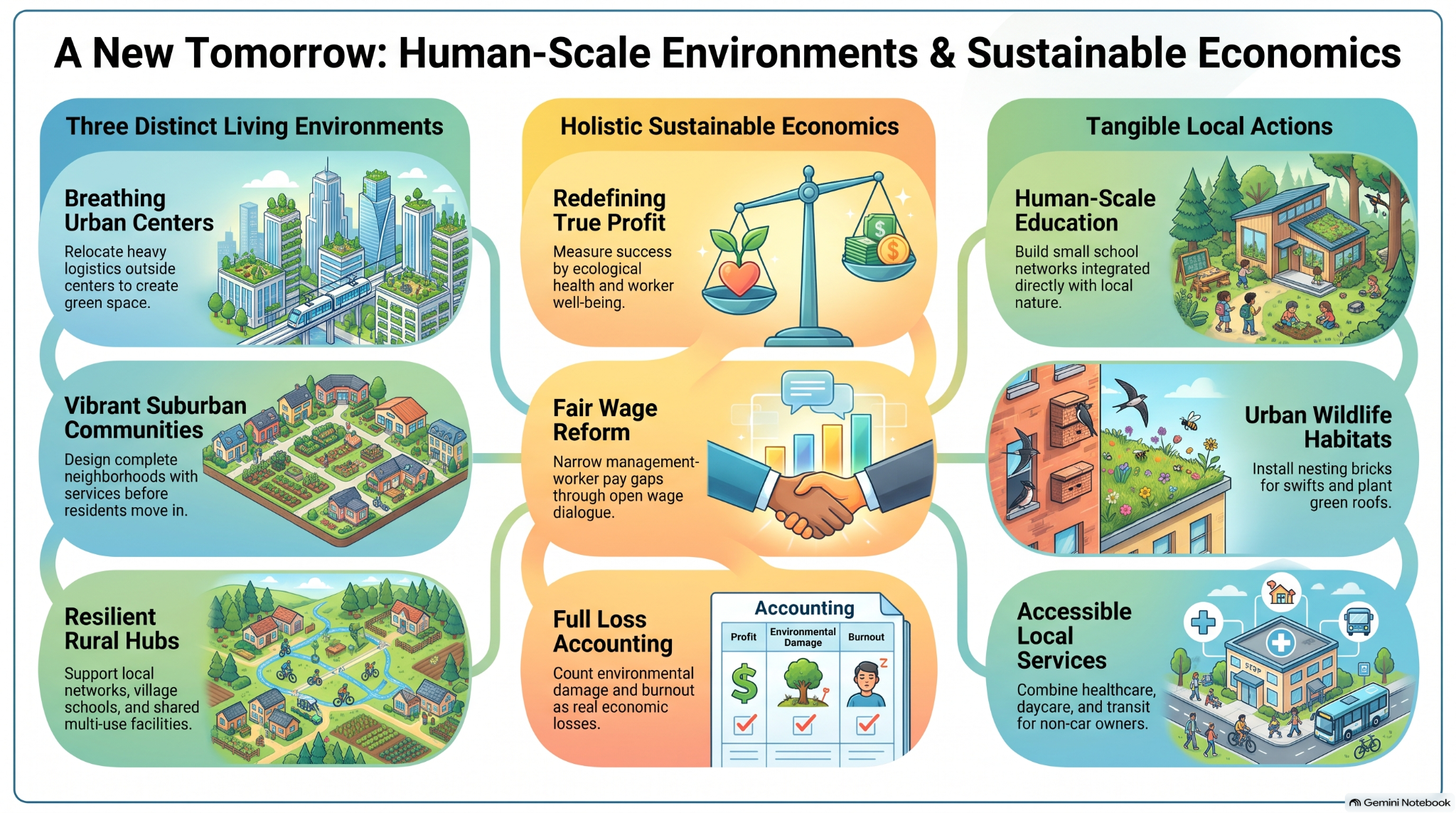
Audio and infographic created with NotebookLM based on this chapter.

How Human-Scale Cities Redefine Profit
A New Tomorrow – infographic