The centralisation trap, blind spots in the economic system and biodiversity
Finland’s geographical paradox
We should ask directly and without disguise: how can Finland afford to let its countryside become deserted and vital living space empty out when many parts of the world face an acute shortage of unspoilt nature, space and natural resources? Should we not instead build a vibrant, functioning society precisely in those areas where diverse ways of life are possible in direct, living interaction with nature?
Previous chapters have shown that nature is the indispensable foundation of all human life and security, and that our history has moved from a close relationship with nature towards deep separation. The statistics have shown how the chain reaction of centralisation has weakened rural services and communities. This chapter moves into a deeper interpretation: why does society continually gravitate towards centralisation, what benefits has it achieved, and what high price do we pay?
The illusion of centralisation: why does the system lean towards it?
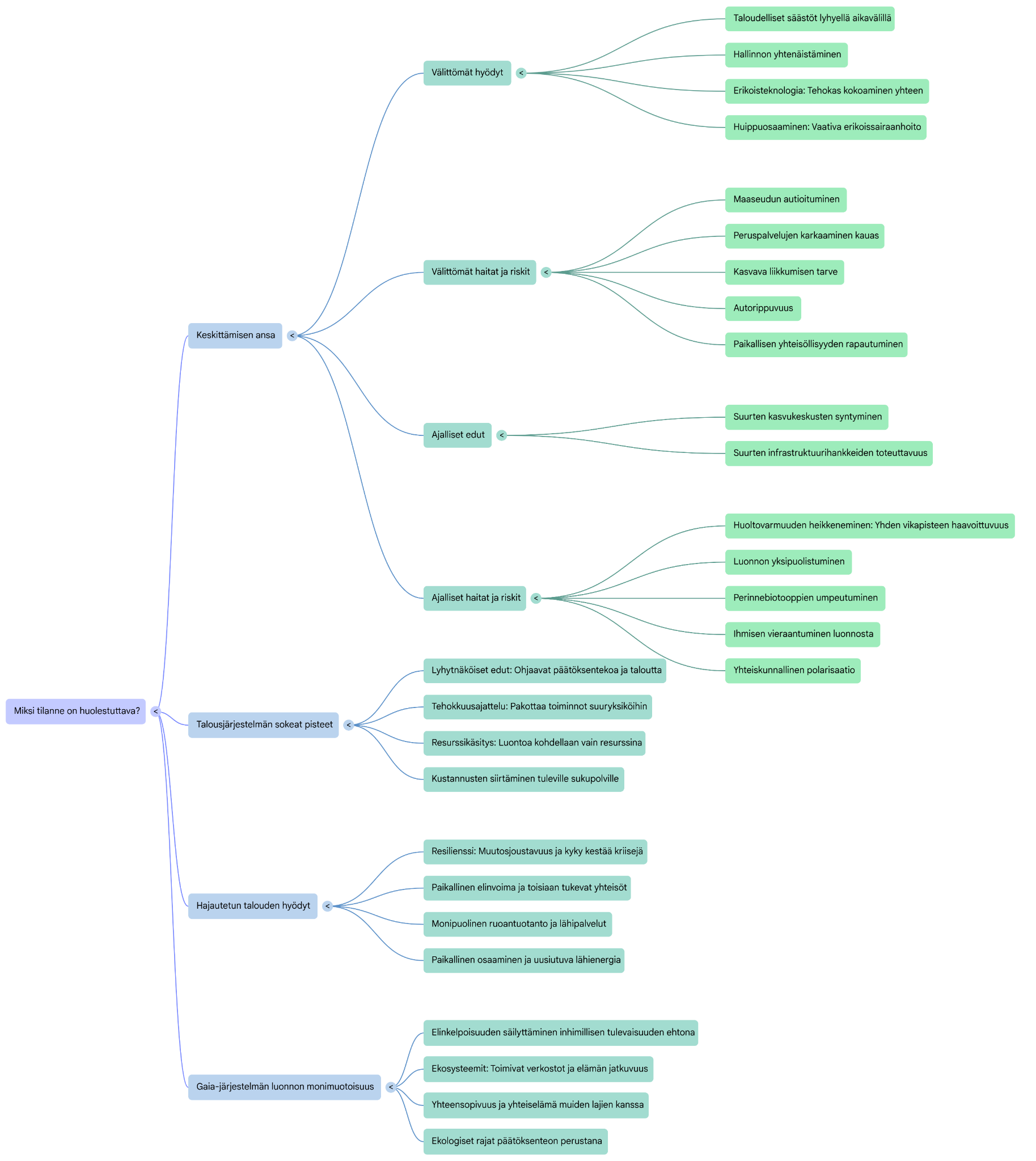
To assess centralisation critically and fairly, we must understand the reasons and immediate benefits that continually draw decision-making towards it. Centralisation has undeniable short-term advantages:
- Economic savings and lower implementation costs: Bringing resources, administration and public services into large units provides immediate economies of scale and saves public funds in the short term.
- Specialisation and advanced expertise: Demanding specialised technology, scientific research and specialised healthcare require substantial resources and experts to be brought together to operate effectively.
- Concentrated infrastructure: In densely populated growing centres, public transport, rail networks and telecommunications can be built to deliver high capacity and efficiency.
The chapter’s guiding principle: centralisation is not itself the problem. The problem arises when it becomes an end in itself instead of a means of improving the wellbeing of people and nature.
The blind spot of savings: maximising profit versus the real benefits of a decentralised economy
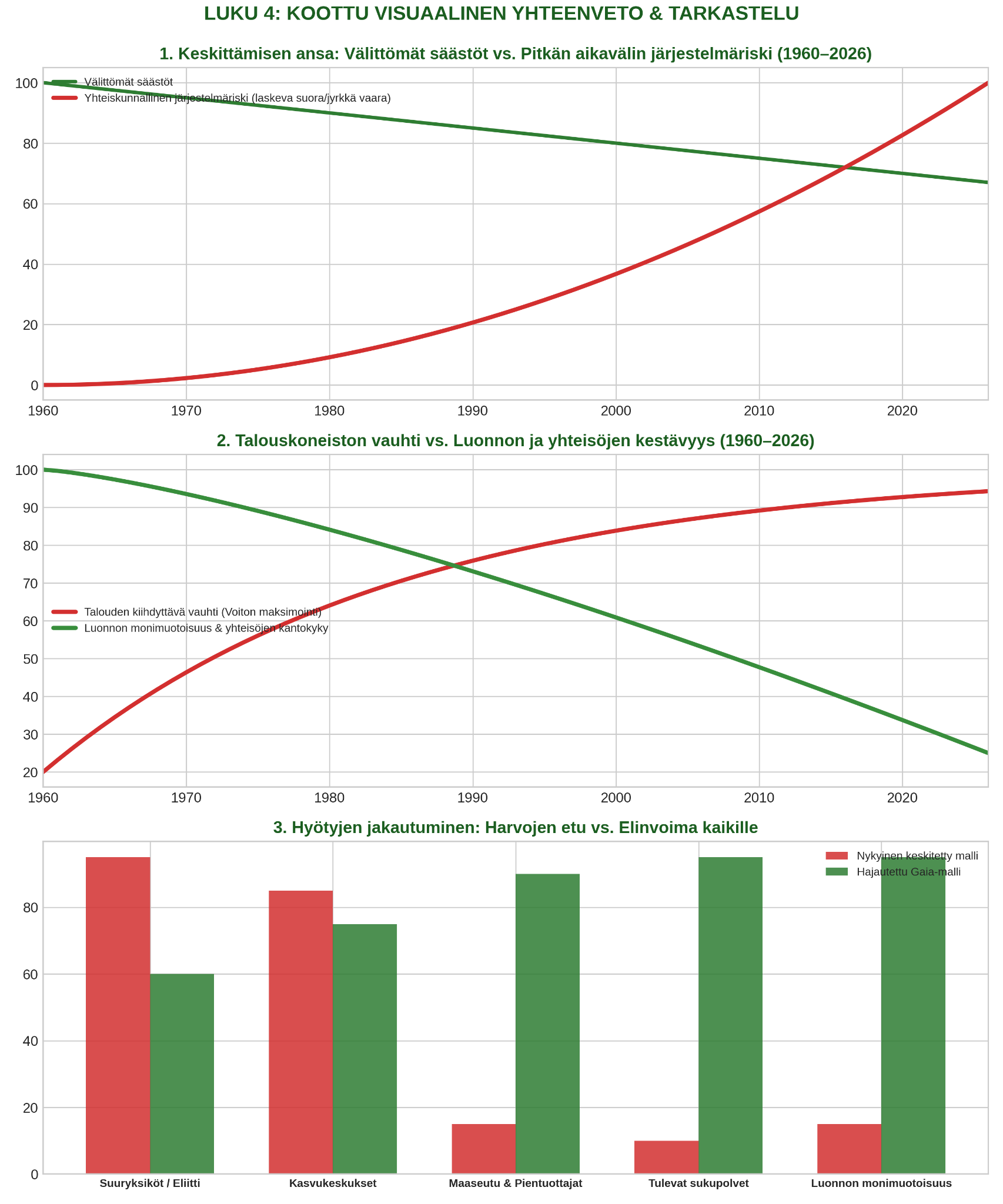
Why, then, is society supposedly unable to afford a decentralised structure, village schools and basic rural services? The reason lies in the foundations of the current economic system: it is based on profit maximisation, continual growth and economic machinery that must keep accelerating to remain standing and deliver ever greater material benefits to a few. When the economy is assessed solely through narrow measures such as short-term productivity and GDP, a decentralised way of life appears “expensive” to the system.
The economic potential of decentralisation and new jobs
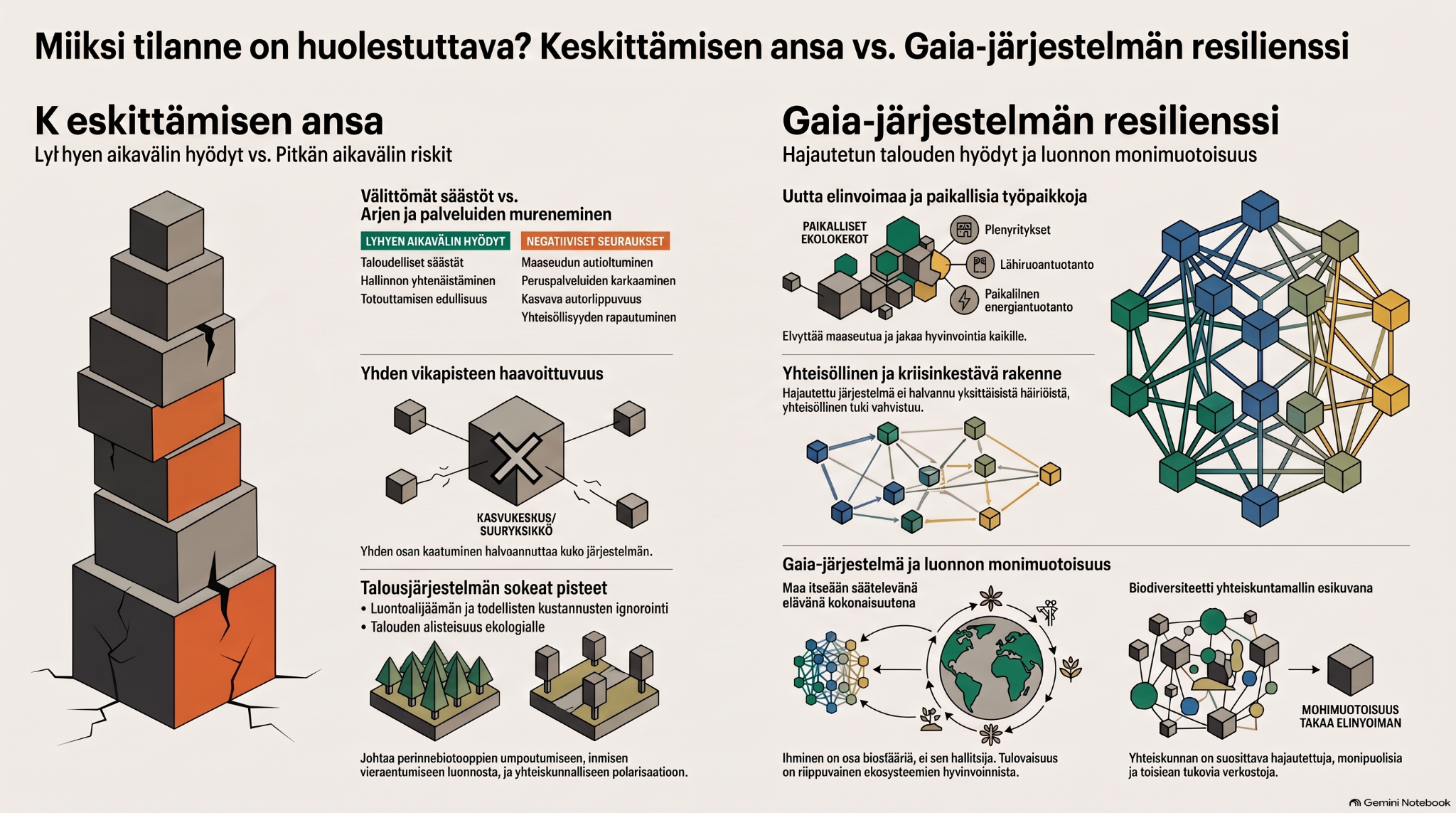
This logic of savings is, however, a serious illusion. A decentralised society is not an economic burden but a vast untapped economic engine. When decentralisation is implemented, new activities — such as distributed renewable energy, local food production and organic farming, the bioeconomy, local tourism and remote work across multiple locations — begin to energise society in new ways.
- New jobs and regional vitality: Decentralisation creates real opportunities for entrepreneurship and work across the country, strengthening municipal tax bases and local purchasing power.
- Fair distribution of benefits: In a centralised model, capital, profits and decision-making flow to a few large organisations and international investors. In the decentralised Gaia model, all citizens and society as a whole benefit from economic vitality, security and wealth, rather than only a narrow elite.
Nature and exploitation: at what price is growth pursued?
A system focused solely on financial profits and large units pays a high price: living nature is treated as an inexhaustible store of raw materials. Biodiversity, soil fertility and forest ecosystems are weakened in pursuit of short-term profit. At the same time, as local community structures are cut to save money, people become exhausted in the rat race, nearby services move away and loneliness increases. Instead of pursuing the common good, people are pushed into a spiral of competitive consumption.
The benefits of centralisation versus adverse consequences and risks
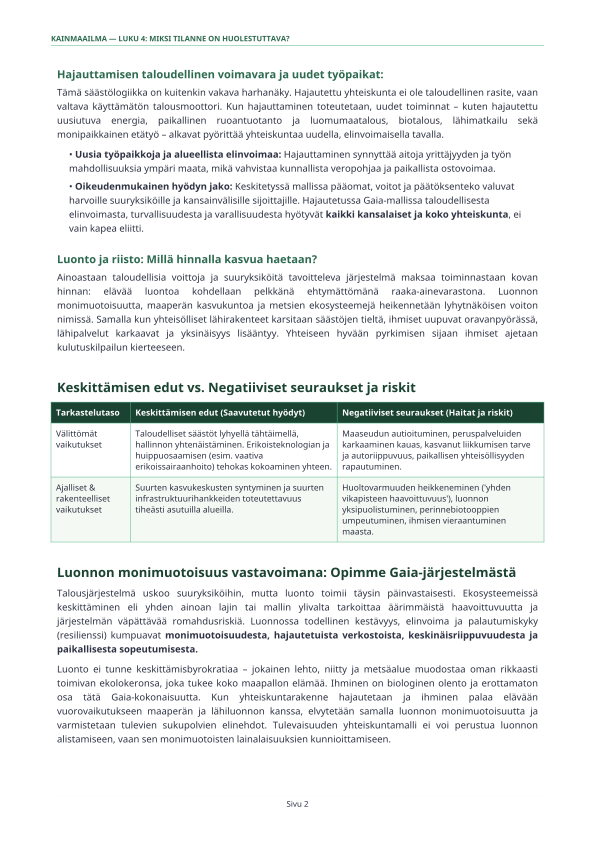
| Level of analysis | Benefits achieved | Adverse consequences and risks |
|---|---|---|
| Immediate effects | Short-term economic savings and harmonised administration. Efficient concentration of specialised technology and advanced expertise, such as highly specialised healthcare. | Rural depopulation, basic services moving far away, greater travel needs and car dependence, and erosion of local community life. |
| Long-term and structural effects | The emergence of major growth centres and the feasibility of large infrastructure projects in densely populated areas. | Weaker security of supply through single points of failure, less diverse nature, overgrown traditional habitats and human estrangement from the land. |
Biodiversity as a counterforce: learning from the Gaia system
The economic system believes in large units, but nature works in the opposite way. In ecosystems, centralisation — the dominance of a single species or model — means extreme vulnerability and a precarious risk of collapse. In nature, real sustainability, vitality and resilience arise from diversity, distributed networks, interdependence and local adaptation.
Nature knows no bureaucracy of centralisation: every grove, meadow and woodland forms its own richly functioning ecological niche that supports life across the planet. Humans are biological beings and inseparable from this Gaia whole. Decentralising society and restoring living interaction with soil and nearby nature also revive biodiversity and safeguard the conditions for future generations. Society’s future model cannot be based on subjugating nature, but on respecting its diverse principles.
Decision time: a choice between two futures
Are we prepared to sacrifice our country’s vitality, security of supply and biodiversity to short-sighted economic machinery that exploits both nature and people to concentrate wealth and decision-making in a few large organisations?
Or will we choose a decentralised Gaia society — a model that creates new economic activity and real jobs throughout Finland, strengthens our connection with nature and ensures that every one of us benefits from society’s achievements and nature’s vitality, rather than only a small elite? Now is the time to decide: does the economy serve people and living nature, or are people and nature reduced to mere cogs in the economy?